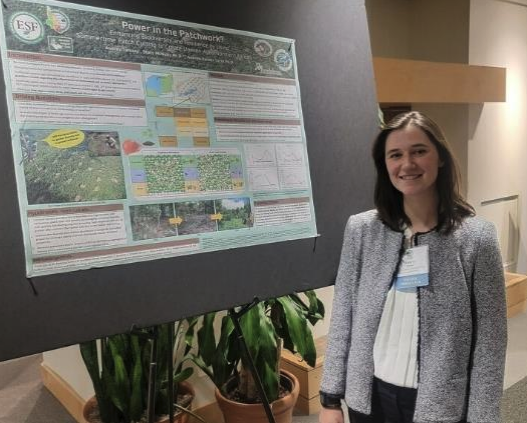
Power in the Patchwork? Enhancing Biodiversity and Resilience by Using Summertime Patch Cutting to Create Uneven-Aged Northern Forests
Principle Investigator: Stacy McNulty, SUNY College of Environmental Science and Forestry
Abstract: Forest resilience in the Northern Forest is being threatened by declines in structural and compositional diversity associated with regeneration failures, herbaceous layer losses, overbrowsing, invasives, wildlife declines, disease, and climate change. Beech Bark Disease (BBD) and Beech Leaf Disease (BLD) have significantly impacted American beech – a critical component of the Northern Forest. Although beech aggressively resprouts, it forms dense thickets that hinder regeneration of other species and BLD may soon alter forest dynamics further. Active forest management can be used to enhance forest biodiversity and resilience, but traditional silviculture often only exacerbates noted issues. We propose evaluating small patch cutting in the growing season as an alternative management strategy. Such an approach may improve the density and diversity of tree regeneration, restore herbaceous diversity, reduce invasive species and beech sprouts, increase bird diversity and abundance, and potentially mitigate impacts of BBD and BLD. We further predict the growing-season timing of harvests will better mitigate the ecological damage and robust beech-sprout response associated with traditional winter season logging – which has shifted to occurring on unfrozen, water-logged soils due to climate change. Using long-term (25 year) datasets and within project-period observations, we will 1) compare our patch cutting approach to traditional large-area shelterwood harvests, 2) employ deer exclosures, 3) assess BLD and 4) examine an alternative to dormant-season harvesting. Our project aims to provide landowners and managers with viable strategies for enhancing biodiversity and resilience in the face of many stressors to benefit both public and private forests across the region.