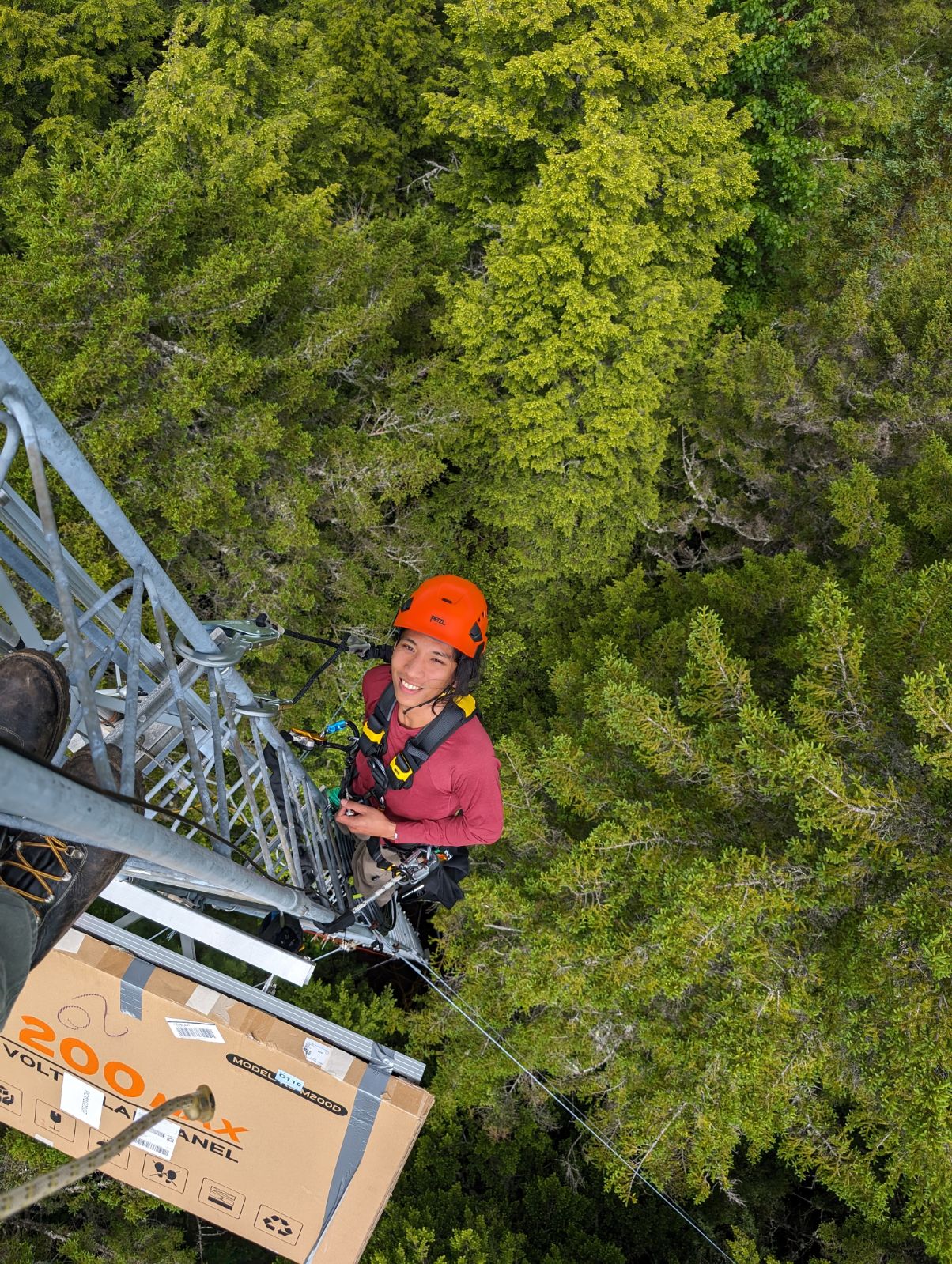
Quantifying Forest Carbon Pools and Fluxes Following Partial Harvest in Northern Conifer Forests
Principal Investigator:
Shawn Fraver, University of Maine, [email protected]
Following commercial clearcutting or severe natural disturbance, forests typically become a carbon source (to the atmosphere) for some time. However, very few studies have addressed the carbon consequences of more typical partial harvests in the Northern Forest. American Forest Management plans to conduct a shelterwood harvest around one of Howland Research Forest’s (central Maine) eddy flux towers (which measure forest CO2 emissions and uptake) during the fall of 2025, while leaving another tower site to serve as a control. Our specific objectives are to (1) Quantify above-ground carbon stock changes resulting from the harvest; (2) Determine if the post-harvest forest becomes a temporary carbon source, and if so, assess how long the source persists; (3) Assess the amount and fate of carbon in wood products harvested from the site and residual material (cull and slash) left on-site post-harvest. We employ a Before-After-Control-Impact study design, where differences in carbon stores and fluxes within the harvested site and unharvested control will be compared before and after the harvest. By combining forest inventories, ground- and tower-level CO2 flux data, LiDAR-derived biomass estimates, carbon projection models, and a new wood product carbon estimator, our project provides a comprehensive assessment of the effects of shelterwood harvests on the carbon budget. Our findings will provide guidance for practitioners interested in including carbon management as one of their objectives. Managers will benefit from both short-term (field measurements over three years) and long-term (modelling) assessments of the carbon consequences of partial harvests.
Student Involvement:
Max Wegner
Marleyla Wiltz